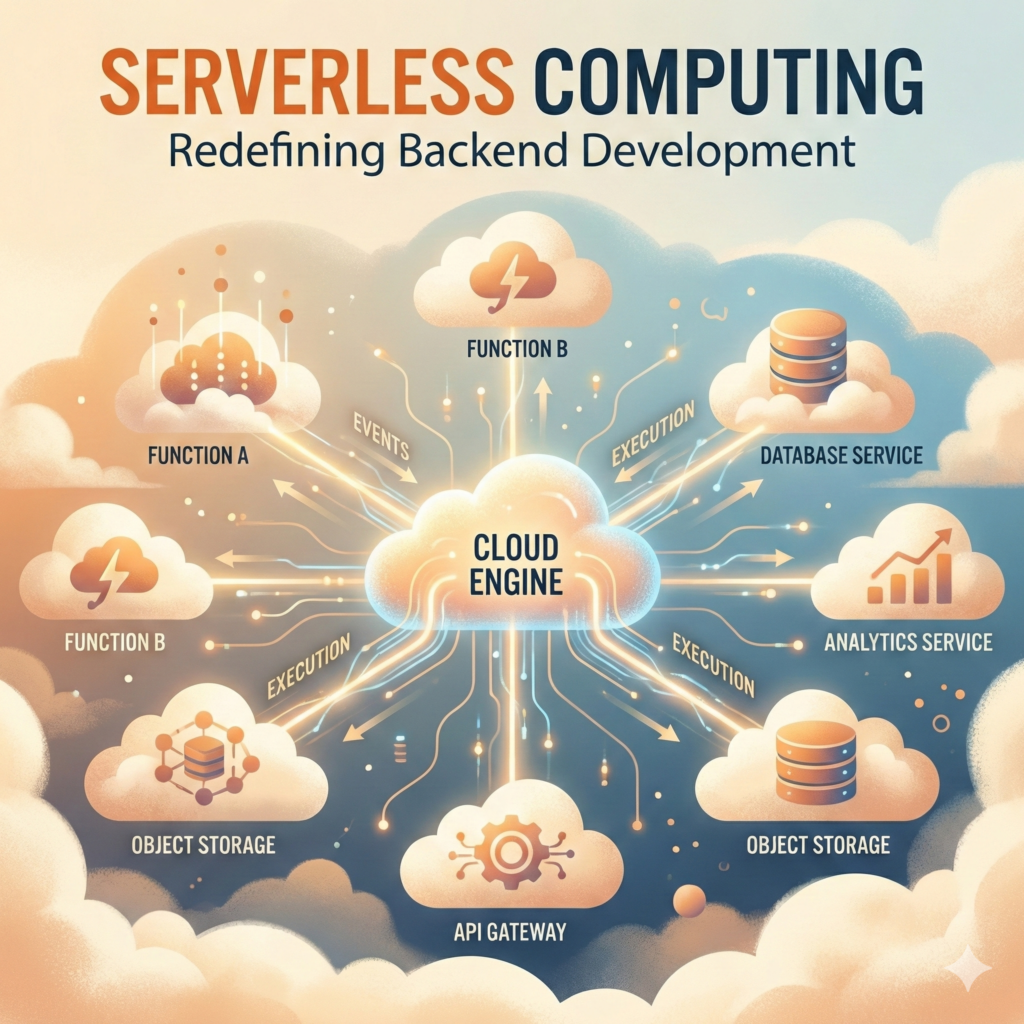


Serverless computing is transforming the way backend systems are built and managed. Instead of provisioning and maintaining servers, developers can focus entirely on writing business logic while cloud providers take care of infrastructure, scaling, and availability.
☁️ What Is Serverless Computing?
In a serverless architecture, backend code runs in response to events such as API requests, database updates, or scheduled tasks. Cloud platforms like AWS Lambda, Azure Functions, and Google Cloud Functions automatically handle:
- Server provisioning
- Scaling based on traffic
- Resource management
- High availability
This eliminates the need for manual infrastructure management and reduces operational overhead.
⚙️ Why Serverless Is Gaining Popularity
Serverless computing offers several key advantages for modern applications:
- Automatic scaling based on real-time demand
- Pay-as-you-use pricing, reducing infrastructure costs
- Faster development cycles
- Improved system reliability
It is especially well-suited for APIs, microservices, background processing, real-time data handling, and event-driven applications.
🚀 A Faster Path to Innovation
By removing infrastructure concerns, serverless enables teams to experiment, deploy, and iterate faster. Developers can release features quickly without worrying about server capacity or maintenance, making it ideal for startups and growing businesses.
Serverless isn’t about removing servers — it’s about removing limitations.