

Modern software systems are becoming increasingly complex, especially as businesses expand across multiple products, services, and workflows. This has renewed interest in Domain-Driven Design (DDD) — an approach that focuses on understanding business problems and designing software around them.
DDD isn’t a new concept, but its principles are becoming increasingly relevant in modern architectures such as microservices and event-driven systems.
🧩 What Is Domain-Driven Design?
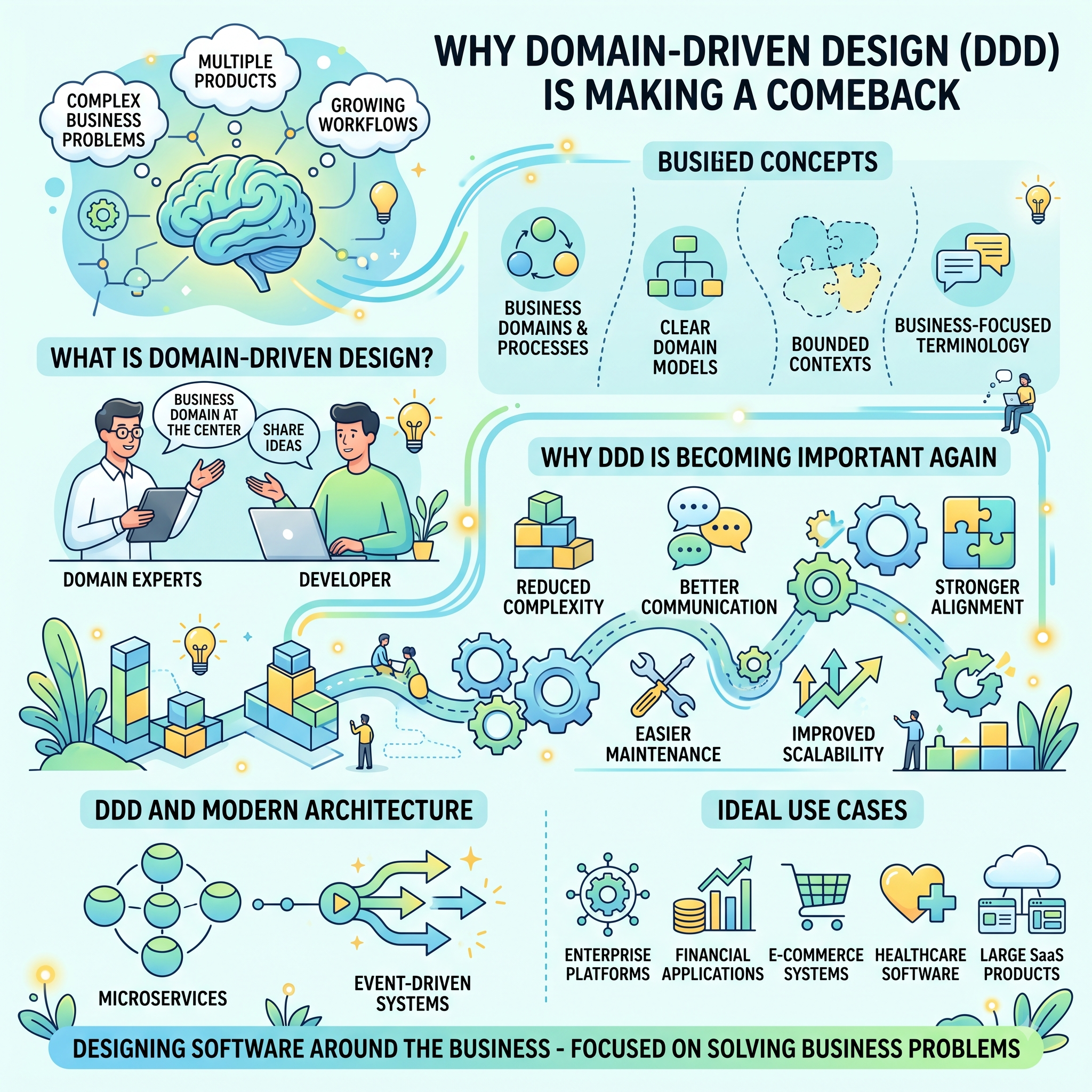
Domain-Driven Design is a software development approach that places the business domain at the center of application design.
Instead of starting with technical components alone, development teams work closely with domain experts to understand how the business operates and translate that knowledge into software models.
DDD focuses on:
• Business domains and processes
• Clear domain models
• Bounded contexts
• Business-focused terminology
• Close collaboration between developers and domain experts
This creates software that better reflects real-world business requirements.
⚙️ Why DDD Is Becoming Important Again
As applications grow larger, simply organizing code into technical layers may not be enough. Teams need a way to manage complex business logic while keeping different parts of a system understandable.
DDD helps by separating large business problems into well-defined areas.
Key advantages include:
• Reduced complexity through clear domain boundaries
• Better communication between technical and business teams
• Easier maintenance of complex business logic
• Improved scalability for large applications
• Stronger alignment between software and business requirements
These benefits make DDD particularly valuable for enterprise applications.
🚀 DDD and Modern Architecture
DDD works especially well with modern software architecture. Concepts such as bounded contexts can naturally align with microservices, while domain events can support event-driven systems.
This allows teams to build applications where individual business capabilities can evolve independently without creating unnecessary dependencies.
DDD can be particularly useful when building:
• Enterprise platforms
• Financial applications
• E-commerce systems
• Healthcare software
• Large SaaS products
🌐 Designing Software Around the Business
The renewed interest in DDD reflects a broader shift toward building software that solves business problems rather than simply implementing technical features.
Technology changes quickly, but understanding the business remains at the heart of great software — and that’s exactly where DDD begins.
