

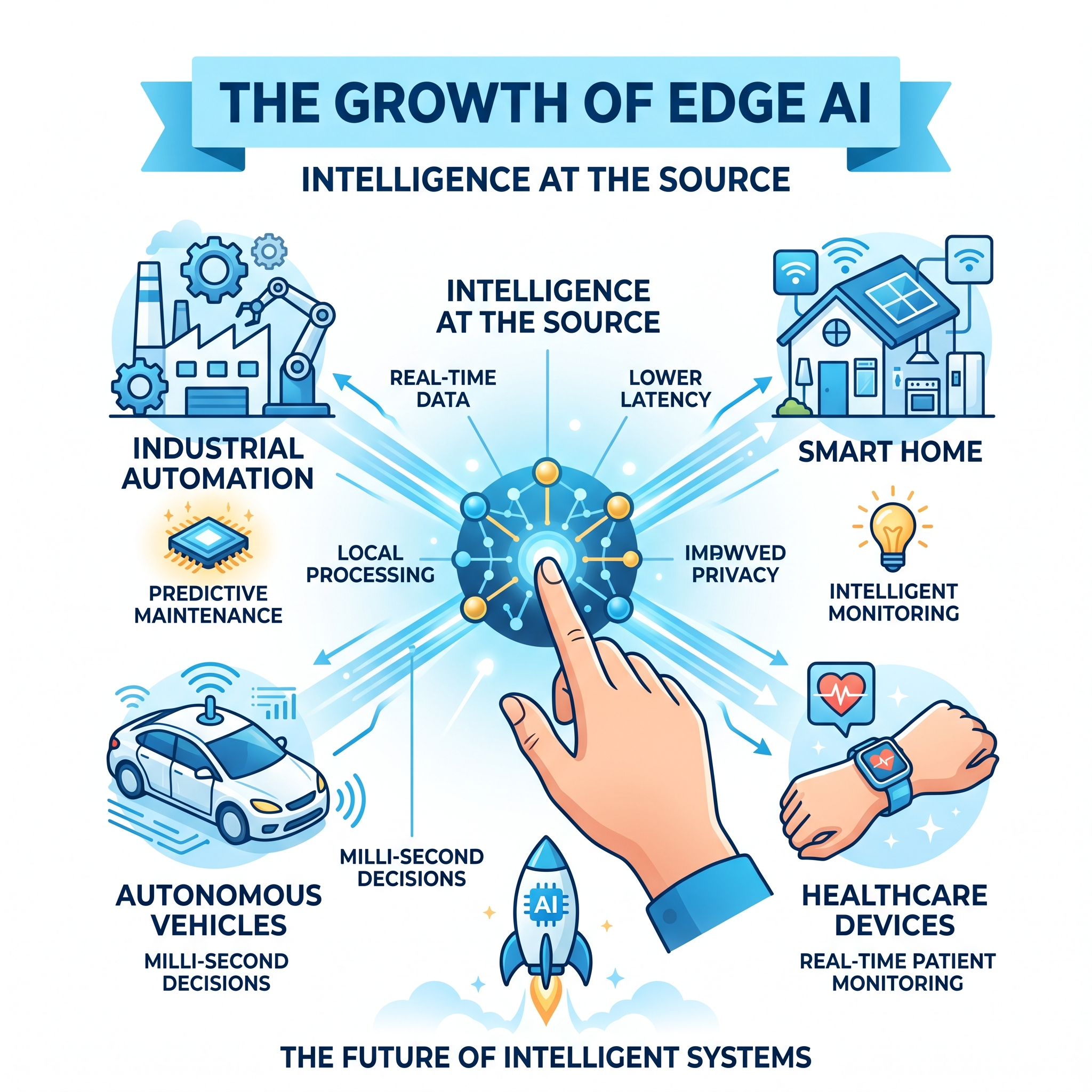
Artificial Intelligence is rapidly evolving, and one of its most exciting advancements is Edge AI. Instead of sending data to cloud servers for processing, Edge AI brings intelligence directly to devices such as smartphones, cameras, sensors, and IoT systems.
By processing information closer to where it is generated, Edge AI enables faster, smarter, and more efficient applications.
🤖 What Is Edge AI?
Edge AI combines artificial intelligence with edge computing, allowing devices to analyze data and make decisions locally.
This approach enables systems to:
• Process data in real time
• Reduce dependence on cloud connectivity
• Respond instantly to changing conditions
• Operate efficiently in remote environments
As a result, applications become more responsive and reliable.
⚡ Why Edge AI Matters
Traditional AI systems often rely on cloud-based processing, which can introduce delays and require constant internet access. Edge AI solves these challenges by bringing computation closer to the source.
Key benefits include:
• Lower latency for faster decision-making
• Improved privacy by keeping sensitive data on the device
• Reduced bandwidth usage and cloud costs
• Greater reliability in areas with limited connectivity
These advantages make Edge AI ideal for real-time applications.
🌐 Real-World Applications
Edge AI is already transforming industries by enabling intelligent systems that react instantly to their environment.
Popular use cases include:
• Smart homes with intelligent automation and monitoring
• Autonomous vehicles that process data in milliseconds
• Industrial automation for predictive maintenance and quality control
• Healthcare devices that provide real-time patient monitoring
As more connected devices emerge, Edge AI continues to expand its impact.
🚀 The Future of Intelligent Systems
The combination of AI, IoT, and edge computing is creating a new generation of smart applications. For developers, Edge AI opens opportunities to build systems that are faster, more efficient, and capable of operating independently.
The future of AI isn’t just in the cloud — it’s at the edge.
